Taking One for the Team  x6
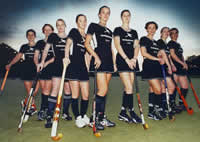 |
| Hockey Heaven's Slimline Uniforms |
March 6, 2001 
Jessica Reed
> Page Views 17035
Would you show the world your peaches to sell peaches?
Louise Dobson of the Australian Olympic field hockey team isnt selling peaches. But thanks to her from-behind, nude photograph, more then just the sales of Australian pears are up.
Dobson isnt the only athlete baring her forbidden fruit for recognition. Elite female athletes around the globe are revealing more than their muscles in the name of sport.
The most notorious example is the nude calendar released by the Matildas -- the Australian women's soccer team as a publicity stunt for sponsorship dollars and recognition heading into the 2000 Olympics. Their naked bodies succeeded in bringing in $ 100,000 in sponsorship and front-page newspaper coverage in the US, Scandinavia, Italy and Japan.
The calendars Ms December, Bridgette Starr, whose naked body appeared captive behind the net said, I'd been playing in the national team since I was 16 and it pissed me off that nobody knew us.
But now when people say the Matildas, they recognize them for their achievements by responding: Oh yes, the calendar.
It's not just the Matildas using their bodies to sell athletics. Black and White, a glossy Australian magazine, published The Sydney Dream, a 236-page special issue featuring 29 male and female members of the Aussie Olympic team. Among them is Hockeyroos captain Rechelle Hawkes, who agreed to a nude shoot on a trampoline to promote women's hockey and the muscularity of the sport.
It seems we have to take off our clothes to get more recognition, said Hawkes.
Western Australia Sports Federation responded on their website saying: These campaigns make the most of these fit, healthy and gorgeous bodies. They are world champions and Olympic champions and it`s unlikely that a few photos will undermine their status as serious athletes.
The women hockey players have demonstrated that with innovation and an acknowledgement of the sex sells principle, they have been able to increase their public profile. This can also benefit the sport as the increase in media coverage and public interest are all critical ingredients in attracting major sponsorship dollars.
While the female Aussie athletes are the gold medallists in the Olympic sport of stripping, they arent the only athletes using their bodies to draw attention to their sport and make some money in the process.
Swimmer Jenny Thompson sent the US media into a frenzy when she appeared in Sport Illustrated before the US Olympic swimming trials wearing red ankle-length boots and a pair of star-spangled banner pants with only her hands over her breasts. Thompson claims she simply wanted to show her fit and muscular body to young girls.
Too bad she took the top off and put the boots on, wrote Linda Robertson, sports columnist for the Miami Herald, "because the muscles are secondary to the covered breasts. The strategically placed hands and the incongruous footwear distract from the magnificent muscles...
Sally Jenkins of the Washington Post said, Thompson isn't showing off her breasts. She is showing off her muscles, it's a crucial distinction."
However, Mary Jo Kane, director of the Tucker Center for Research on Girls & Women in Sport at the University of Minnesota seems to be unclear as to: "which muscle group naked breasts belong to."
Also, the Canadian women's cross-country ski team produced the Nordic Nudes calendar as a way to invite attention to their sport.
Team member Sara Renner told The Calgary Herald, "... this is a way to get cross-country skiing as a household sport, even if we have to take our clothes off to do it."
Other athletes, while keeping the majority of their uniform on, seem to be wearing as little of it as possible to get more press.
The British Olympic Field Hockey Team was well supported in all their endeavours thanks to Britains largest retailer Marks & Spencer. Lucilla Wright, Kate Walsh, Denise Marston-Smith, Anna Bennett and Fiona Greenham posed for their proud supporters in their M&S sports bras in a picture that appeared in Hockey Sport, September 2000.
The Australian national team was, once again, first to ditch the traditional hockey kit for tighter fitting, lycra dresses, followed by the New Zealanders and the Germans.
This new kit is drawing attention not only for elite international players, but most recently for a club team in England. The Hightown Hockey Team players, thanks to sponsor hockeyheaven, are also sporting the lycra dresses.
You have to play dirty sometimes, said Deep Bassi, managing director for Hockeyheaven.
Any publicity is good publicity in field hockey, said Bassi. As far as Im concerned Im providing a service to the sport.
But not everyone agrees that if youve got it you should flaunt it. The Women's Sports Foundation, based in Nassau, New York, takes the position: This is what the audience wants and, This is what sells would not be tolerated if the images perpetuated racist or anti-semitic stereotypes. The position should not be tolerated if the images perpetuate the stereotype of women as sex objects.
The Womens Sport Foundation supports portraying females in ways that emphasize their skills as athletes, not as bathing beauties. The foundation also rejects the practice of advertisers or promoters who use sexist imagery to sell women athletes as sex objects rather than as athletes.
USA Today columnist Christine Brennan suggested that pictures, such as the one of Thompson, sends girls the insecure message that an old stereotype still lives and thrives.
SIDEBARS:
On Michael Jordan posing for Hanes underwear:
The difference between Jordan and female athletes is that Jordan is remembered primarily for his six NBA championships, his game-winning performances and his gravity-defying dunks, not his underwear shots.
-Mark OKeefe, New House News Service
If there's a competition going on, it's between old and new images. For every Mia Hamm there are still dozens of supermodels. For every message of self-confidence there are still a stunning number of folks investing in feel-bad visuals.
-Ellen Goodman, Boston Globe
According to Rosemary Hehir, head of the Victorian YWCA, which actively supports sports programs for young women, the difference is that Rafter's tennis achievements were recognised long before he took off his shirt for the Ray-Ban sunglasses advertisement. The Matildas, says Hehir, were recognised for taking their shirts off rather than for their achievements.
- Richard Yallop, The Weekend Australian
Swimmer Sarah Ryan. "I'm not going to train every day and watch what I eat for the rest of my life. We put a lot of work into our bodies, so I see this as a kind of record a lasting memory of how fit I once was."

Your opinion counts.
Rate this article or enter your comments below.
|